

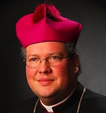
Prime Bishop Anthony Mikovsky
The Produce of the Kingdom
As we move in the season of Fall and come to the last number of Sundays within our liturgical year, we encounter a number of Gospel readings taken from the last week within the life of our Lord before His passion, death, burial and ultimately His Resurrection. While we certainly did encounter some of these readings during the season of Lent and especially within the readings of Holy Week, at this time of the year we encounter them again as we are focusing on the final teachings of our Lord and especially those for His followers to put into action in the time of the Church to come after His Ascension.
When our Lord arrives in the city of Jerusalem, He comes into contact with the temple authorities and the religious leaders of the people. Jesus challenges them when on the first full day of His time in Jerusalem, He comes to the temple and drives out the money changers and those who are making a business of religion.
The chief priests and elders then come to confront Jesus and question where He gets the authority to do these things. While Jesus refuses to answer them directly He gives them a number of parables concerning the religious life, including the parable of the landowner given on the 27th Sunday of Ordinary Time this year.
[Jesus says to the chief priests and elders,] “Listen to another parable. There was a landowner who planted a vineyard, put a fence around it, dug a wine press in it, and built a watchtower. Then he leased it to tenants and went to another country. When the harvest time had come, he sent his slaves to the tenants to collect his produce. But the tenants seized his slaves and beat one, killed another, and stoned another. Again he sent other slaves, more than the first; and they treated them in the same way. Finally he sent his son to them, saying, ‘They will respect my son.’ But when the tenants saw the son, they said to themselves, ‘This is the heir; come, let us kill him and get his inheritance.’ So they seized him, threw him out of the vineyard, and killed him. Now when the owner of the vineyard comes, what will he do to those tenants?”
“They said to Him, ‘He will put those wretches to a miserable death, and lease the vineyard to other tenants who will give him the produce at the harvest time.’”
“Jesus said to them, ‘Have you never read in the scriptures: “The stone that the builders rejected has become the cornerstone; this was the Lord’s doing, and it is amazing in our eyes”? Therefore I tell you, the kingdom of God will be taken away from you and given to a people that produces the fruits of the kingdom.’” (Matthew 21:33-43)
Within this reading the chief priests and elders are forced to admit that these tenants are acting in an evil way, taking the blessings that the landowner has provided and, not only keeping the produce, the fruits, for themselves, but then even going as far to kill the son, in an attempt to possess all of it for themselves. These tenants took for granted that they had received much from the owner, and only sought to be selfish.
The leaders also must have been cut to heart knowing that this parable describes the whole history of the people of Israel and it exposed their role within that history. The giveaway is right from the beginning when it is describes the situation as a vineyard. The image of a vineyard has traditionally been an image of God’s chosen work in the world. Likewise these leaders would certainly have known that the ‘slaves of the owner,’ the prophets, were treated poorly by the leaders and the people to say the least. The prophets, like the slaves in the parable, were beat, killed and stoned.
But as individual followers of our Lord and Savior Jesus Christ, we must also realize that this parable speaks to each of us, exactly as individuals. We can each examine the parable in light of our own daily living and the individual fruit that we produce for Almighty God.
If we give it some thought, we can certainly say that we have been given many blessings from Almighty God. Just like the landowner provided, not only the vineyard, but also the wall, the press and the watchtower. We too have been provided with our very lives, just like the vineyard. We have been given the Church, our families and communities as well, as places where the good work of the Kingdom can be done, just like the wine press. And also the teachings and the authorities of the Church acting like a watchtower as a guide and protection in our journey through life.
But then the question comes to us, will we be like those tenants who consider that we owe nothing to Almighty God and strive rather to keep all of this productive work for ourselves giving nothing back. Even if we cannot fully see what we are doing, just like the parable, God will continue to offer us the opportunity to turn to Him, reform our lives and realize our true relationship to Him.
And in fact, we also know that the ‘son of the owner,’ our Lord Jesus Christ, has also been sent to us within our lives and especially within the Church. But what will our attitude be when we encounter Him?
Jesus is the one that offers to us forgiveness of sins and the opportunity to embrace eternal life. Will we ignore His saving death and life giving Resurrection and instead seek to go our own way and imagine that all that we have and do within our lives is our own doing?
As we approach the end of the liturgical year and we begin to focus our attention on the goal of our lives and ultimately where we will spend eternity, let us know that we are workers within the vineyard of the Lord. He has provided us with so very much and because He loves us, we are offered an opportunity to fully partake of the fruits of His kingdom. But we must acknowledge that the Vineyard is His. He is the Lord of our lives and the Lord of all creation. He calls us to participation in the Kingdom and work to produce the fruit of the Kingdom that will remain.
At the end of the parable, Jesus tells the leaders of the people, that ‘the Kingdom of God will be given to a people that produces the fruits of the Kingdom.’ These fruits are shown within our lives both within our internal disposition and within our outward actions. Inwardly, we are to embrace the nine fruits of the Spirit. These are, ‘love, joy, peace, patience, kindness, goodness, faithfulness, gentleness and self-control.’ We are to not only embrace them, but to strive to strengthen them and encourage others to live them as well. And then, using these fruits of the Spirit, we should then go about producing fruits in our outward actions, ‘repentance and obedience to the ways of God, works of charity and loving kindness, and also evangelism as we share the good news of Jesus Christ with everyone we encounter.
Let us, as we reflect on the end of the liturgical year, pray to Almighty God that we will be thankful for the many gifts He has given us, and through that connection to God, make the concerned effort to produce the fruits of the Kingdom, love for God and for each other.