

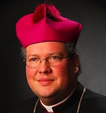
Prime Bishop Anthony Mikovsky
The Glory of God
As we find ourselves working through the weeks of the Easter season following the joyous Sunday of the Resurrection, we begin to change our focus a bit during our Sunday readings. Early on following Easter Sunday we are focused on the empty tomb and the first appearances of Jesus after the resurrection. On Easter Sunday we encounter the empty tomb. The women go to the tomb to anoint the body of Jesus and find the stone rolled away. A angel tells them that Jesus has been raised. Then on the second Sunday, we have Jesus appearing to the gathered apostles on the evening of that same day of the resurrection, as well as one week later when Thomas is there with them. But beginning with the Fourth Sunday of Easter, Good Shepherd Sunday, and continuing for the rest of Eastertide, we begin to reflect on the meaning of the Lord’s resurrection for us and the Church. In order to do this, we begin to reflect back on the earlier sayings of our Lord and applying the knowledge of the resurrection to them. In fact, we acknowledge that this is exactly what is occurring in the entirety of Scripture, since all of the Gospels were written in light of the resurrection of our Lord that was accomplished at Easter.
On the fifth Sunday of Easter this year, we read a portion of what is known as the Book of Glory, from the Gospel of John. This is the significant portion of John’s Gospel that takes place at the Last Supper, while Jesus is teaching His disciples.
In the Gospel we read: “When he [Judas] had left, Jesus said, ‘Now is the Son of Man glorified, and God is glorified in Him. If God is glorified in Him, God will also glorify Him in Himself, and He will glorify Him at once. My children, I will be with you only a little while longer. You will look for Me, and as I told the Jews, “Where I go you cannot come,” so now I say it to you. I give you a new commandment: love one another. As I have loved you, so you also should love one another. This is how all will know that you are My disciples, if you have love for one another.’” (John 13:31-35)
The word ‘glory’ or ‘glorify’ here is one that can be a bit confusing for us. We tend to think that when glory is used, it is for something that is beautiful or highly admired. When we hear the word ‘glory’ our first thoughts do not immediately go to the cross. But John is using it in a bit of a different way. He is taking here the Old Testament concept and applying it to the ministry, the person and actions of Jesus, especially His offering of Himself on the cross. Within the Old Testament, the phrase, ‘the glory of the Lord’ was used to show a manifestation of the divine presence within the world. It signified a revelation of God’s power shown to humans.
Within the Gospel of John, this discussion of glory comes immediately following Jesus getting down on His hands and knees to wash the feet of the disciples. In performing this action Jesus takes the most lowly of positions in order to do an act of love to His disciples. He reminds them afterward that “I have given you a model to follow, so that as I have done for you, you should also do.” (John 13:15)
As we examine this action of our Lord, especially after considering His death upon the cross and His resurrection, we see within it that Jesus takes the lowliest of positions within His culture, to express the reality of God taking upon Himself the lowliness of human nature, and then laying down this life for our salvation. Not only is the foot washing to be the model for us to follow, but more importantly we are to follow the model of laying down our lives for one another. We are called into a life of all self-sacrificing love and service This is the love that we are called upon to express.
It is within this laying down of Jesus’ life that we experience the glory of the Lord. It is the revelation of exactly how much God loves His people. This is why we can say that the crucifixion of Jesus is an expression of the glory of the Lord. It is a revelation of God’s power in the world. It may have seemed like weakness, but in fact it was the very power of God conquering sin and death. And then, through the resurrection of Christ, God extends to us everlasting life when we join our lives to Christ’s Own life.
It is for this reason that Jesus says within the reading above that, “I give you a new commandment, love one another. As I have loved you, so you also should love one another.” (John 13:34) This commandment is not new in time. This is not a different commandment. Saying that we should love is not a new understanding from God. Rather, the commandment is new in intensity. We should not only love, but we should do it in the way that Jesus has. We should take the self-offering position of service to help our brothers and sisters. We should give all that we are able to help and serve others. We should unite our own giving to that of Jesus. If we join our lives of love and service to that of Jesus, then as we reflect during this Easter season, we will be joined to the resurrection life of Jesus as well.
Within the second reading for the same Fifth Sunday of Easter, we read in the Book of Revelation, John proclaiming, “I saw a new heaven and a new earth … I also saw the holy city, a new Jerusalem. … Behold, God’s dwelling is with the human race.” (Revelation 21:1a, 2a, 3a) We see here that something new is being inaugurated. While the Book of Revelation is often looked at as describing those things that will happen at some future time at the end of the world, we can also see that what is described there is also beginning to happen in our own time. It is sometimes described as “already, but not yet.” It is something that has certainly begun, but is not yet fully accomplished.
Because of the Resurrection of Jesus Christ from the dead, all things have been joyously transformed. We, as a part of the Church today, fully participate in this transformation. But as above it is something that is “already, but not yet.” Christ is risen from the dead as the firstfruits. We in the Church today are participants in this renewal of all creation as we wait for the full consummation of this renewal. St. Paul confesses concerning Jesus in his First Letter to the Corinthians: “But now Christ has been raised from the dead, the firstfruits of those who have fallen asleep … Christ the firstfruits; then, at His coming, those who belong to Christ.” (1 Corinthians 15:20, 23)
This reality is the cause and result of our Easter joy. Jesus Christ has been raised from the dead to new life. He has won the forgiveness of sin by His death upon the cross and then conquered death by being raised to life again in the glory of the Father.
In our worship in the Easter season and in our Easter joy we confess that Jesus Christ is “the head of the body, the church. He is the beginning, the firstborn from the dead, that in all things He Himself might be preeminent. For in Him all the fullness was pleased to dwell, and through Him to reconcile all things for Him, making peace by the blood of His cross. (Colossians 1:18-20)
Let our Easter joy, our Easter worship, our singing of alleluia during this time, show forth that the renewal and transformation of all things in Christ is bring lived strongly in how we love each other and offer our service to God and neighbor.